5 min read
Mural or roll: choosing wallpaper for a living room
Two different things hide behind the word “wallpaper”. A mural is one composition for the whole wall; a roll is a repeating pattern. Here is how they differ in the work, in the quantities, and in how they look in your own light.
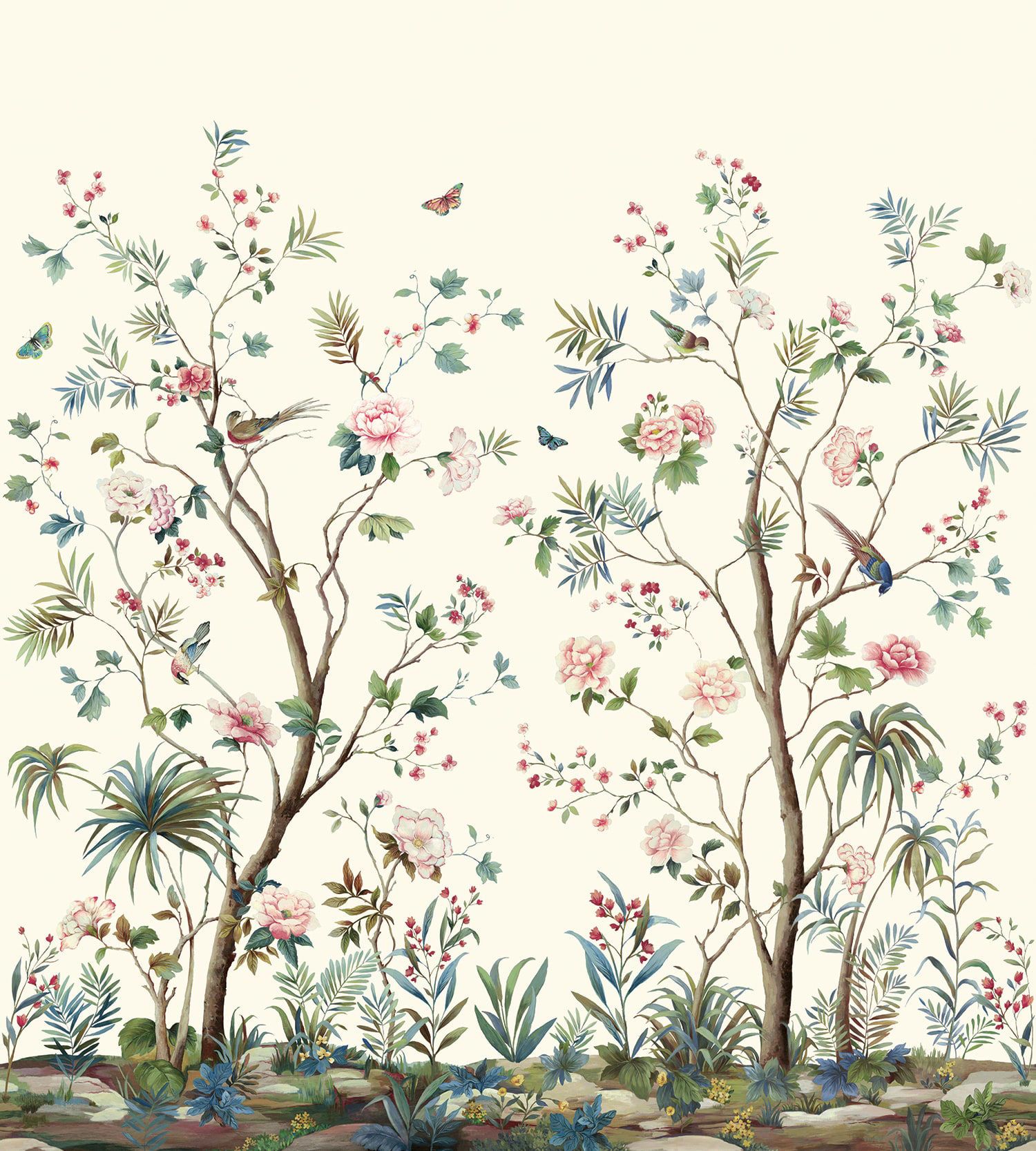
When a living room needs that one wall, the choice usually comes down to two formats. A mural is a single image printed to the size of a specific wall: a garden, a landscape, large branches, birds. A roll is a design that repeats at a fixed interval, and the wall is built up from identical drops. Both are made by the same mills, from the same materials — non-woven, vinyl on non-woven, textile. The difference is not quality but logic.
A mural behaves like a painting: it has a centre, an edge and a scale tied to your wall. A roll behaves like a fabric: it can cover any area, be cut around a window, continue onto the next wall. Everything else follows from this — how you measure, how you count quantities and what you end up with.
Pattern repeat and quantities
Patterned roll wallpaper has a repeat — the vertical distance after which the design recurs. Plain and textured papers have none; a small motif might repeat every 10–15 cm, a large one every 60–70 cm or more. The larger the repeat, the more goes to waste: each following drop has to be shifted so that the pattern lines up at the seam.
The working calculation is simple. Wall height plus one repeat is the length of one drop. Divide the roll length by that figure and you have the number of drops per roll. Drops are cut to whole repeats: for a 2.5 m wall and a 64 cm repeat one drop is four repeats, 2.56 m, so a 10 m roll yields three drops, not the four you would get from an unpatterned paper. This is normal — every large-scale collection works this way — but it is worth knowing before ordering rather than after.
A mural has no repeat. The composition comes as a ready set of panels of a fixed size — width and height are listed on every mural's page in the catalogue. There is nothing to calculate: you check the wall against the mural size, and the installer allows for the edge margin and the trim to ceiling height when hanging.
Panel width and the wall
A standard roll is 53 cm wide; several European mills use 70 cm, and wide non-wovens come at 106 cm. Murals are printed in panels of various widths: in American collections such as Daisy Bennet and Chinoiserie it is a set of panels that together form a composition about 2–2.7 m wide by roughly 3 m high. If the wall is wider, the mural is doubled or a composition with a continuation is chosen.
This is where openings need deciding in advance. A door or window on the mural wall is cut out of the composition, and part of the image is lost. Sometimes that is beautiful — branches disappearing behind the architrave — but it is better seen in a mock-up than on the wall. With rolls, openings hardly matter: the pattern continues and the seams match.
Then there is furniture. A mural behind a sofa or a bedhead is usually read by its upper half, so the composition should be chosen so that the main subject sits above 90–100 cm from the floor. A roll is neutral in this respect: the pattern is even, and it does not matter which part a cabinet covers.
Light in the room
Wallpaper lives in your light, not the showroom’s. North-facing windows give an even, cool light in which warm cream grounds look greyer and metallic finishes lose their sheen. South- and west-facing windows give warm light and hard shadows in the evening — matte textures and muted tones do well there, while gloss and foil can glare.
A large-scale mural is best on the wall opposite the window or to one side of it: on the wall between windows it sits in backlight and the detail disappears. Textured rolls, on the contrary, gain from side light — it brings out the relief.
Pay attention to evening lighting too. If the living room has warm lamps and uplighting, a pattern with metallic thread or pearlescent finish “switches on” in the evening and behaves quite differently by day. That is not a flaw, but it is something to see before you order.
Samples in the showroom
The only reliable way to choose is to see a sample in place. Our showroom in Astana works by appointment: ahead of the visit we pull colourways and full-size fragments for your project, so that you are not leafing through fifty catalogues in a row. A sample can be taken to the site and held against the wall in the morning and in the evening — after that, doubts usually disappear.
A mural can only be seen whole in a mock-up: we lay it out at the scale of your wall, with openings and furniture, to see where the centre of the composition will fall. Rolls are simpler — a fragment with one full repeat is enough.
Orders go directly to the mill: we work on direct factory contracts, so lead time and delivery cost are known upfront, and the batch is printed in one run — the shade matches across every drop.
So which one
A mural — when the room has one main wall visible from the entrance and you want it to set the mood. It works as a piece: it has a subject and a scale, and needs nothing beyond calm neighbouring walls.
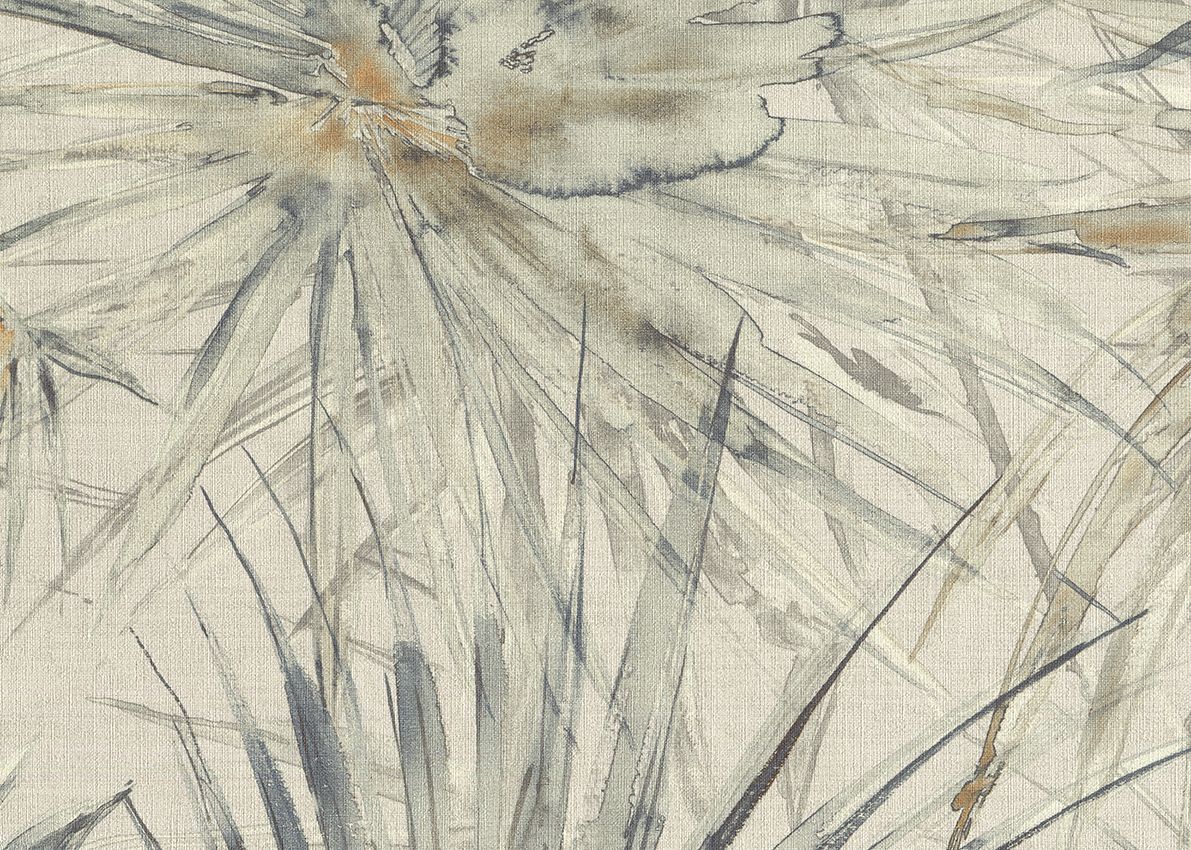
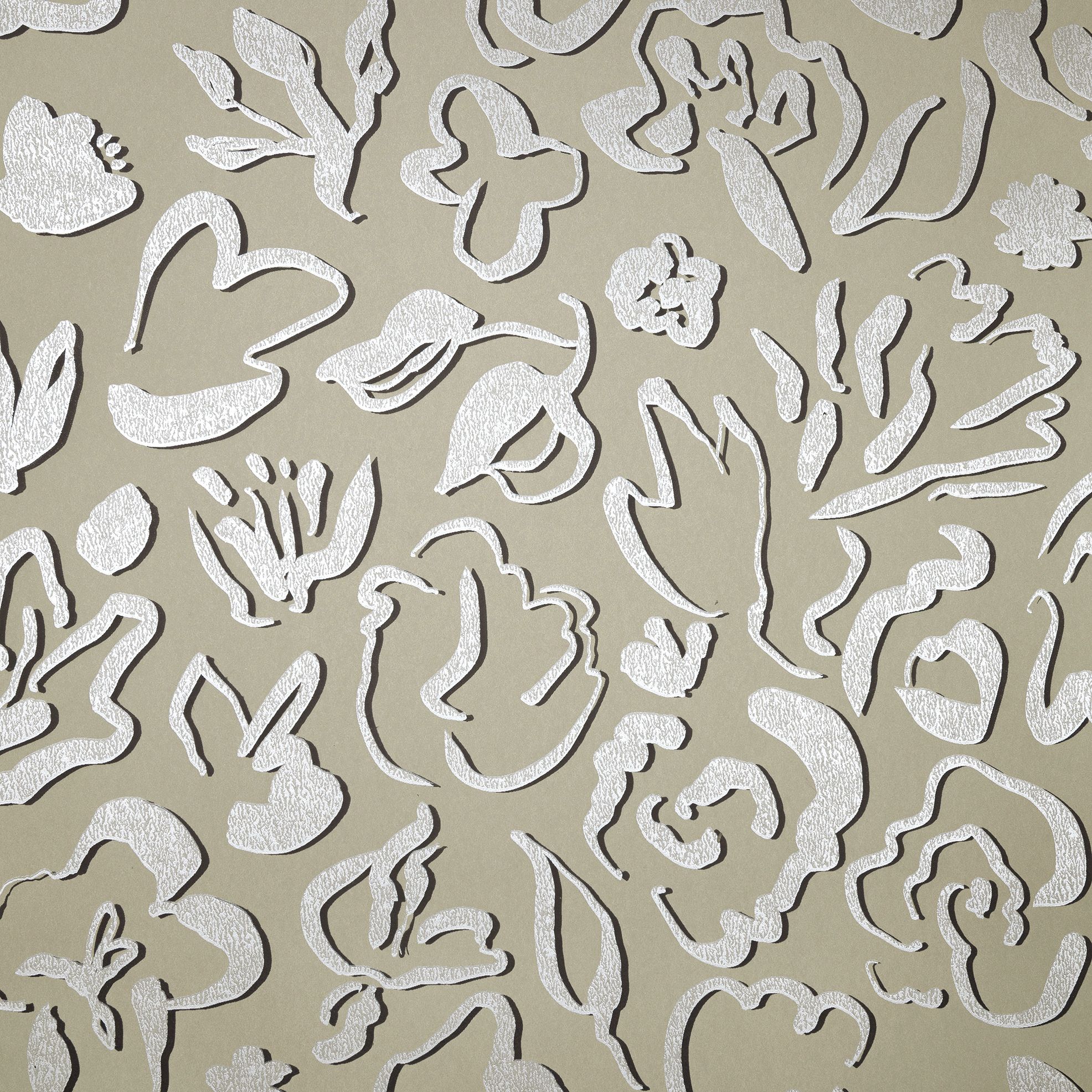
A roll — when you need rhythm across several walls, when there are many openings, when the room already has its accent — a painting, a rug, a large piece of furniture. A textured or small-patterned roll is the ground that holds the interior together without arguing with it.
Often the right answer is both: a mural on one wall and a quiet roll from the same collection on the others. Most of the mills we work with release them in pairs for exactly this purpose.
Catalogue
See it in the catalogue
Wallpapers, fabrics and rugs are already in the catalogue, with colourways and sizes; wallpapers and Mohebban rugs carry prices, fabrics and Illulian are on request. Curtains and the rest we show in person.


Showroom
Let’s continue in the showroom
Ahead of the visit we prepare samples for your project — wallpapers, fabrics and rugs can be seen in one light and held against each other. Astana, by appointment.
- Address
- Astana, Baglan lane, 5Show on map
- Hours
- Daily from 10:00, visits by appointment
- Contacts
- +7 702 599 1333WhatsApp