6 min read
How curtains are calculated: measuring, drop and fullness
Fabric for curtains is not “window width times two”. Here is what the atelier actually measures, where the fullness ratio of 1.8–2.5 comes from, and why hems, lining and the fixing decide more than you would think.
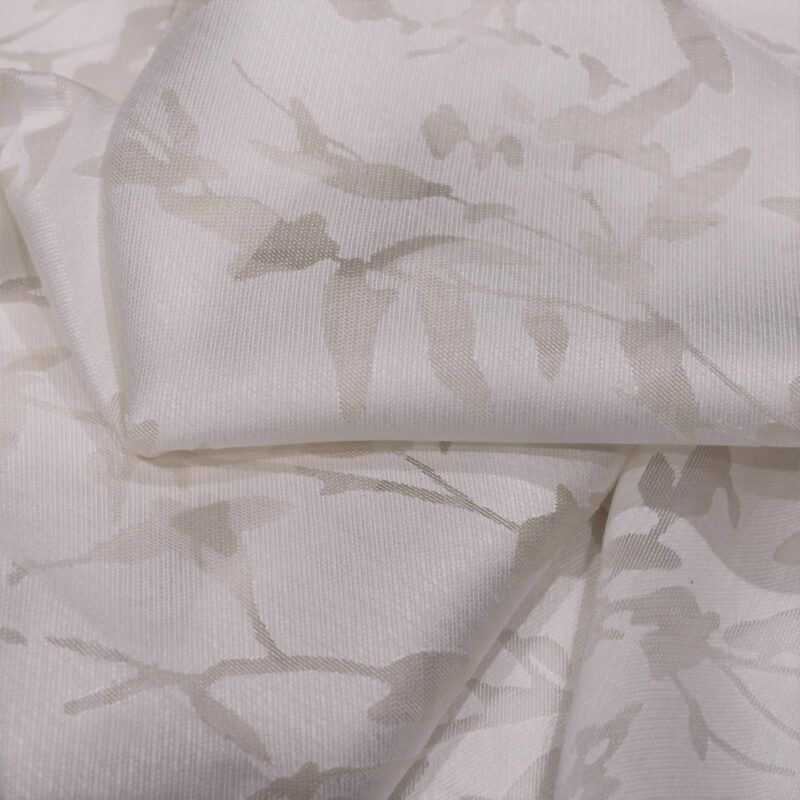
Curtains are the one thing in an interior you cannot buy ready-made and simply put in place. They are made for the window, the track, the ceiling height and the way you want the fabric to fall. That is why every project in our atelier starts with measuring on site, and only then does a figure in metres appear.
Below is what happens between “we need curtains for the living room” and a finished window. Not so that you calculate it yourself, but so that you understand what makes up the quantity and why two curtains that look alike can differ twofold in fabric.
What the atelier measures
The fitter arrives with a tape, a laser and a level and measures not the window but the whole wall. The width of the opening and the distance to the side walls — to see how far the track can extend beyond the window. The floor-to-ceiling height at three points — ceilings are rarely perfectly level, and a 1.5 cm difference across a three-metre window shows. The height from the ceiling to the top of the opening — for a ceiling-fixed track it decides whether a gap will be visible.
Everything that gets in the way of the fabric is recorded separately: the radiator and its depth, the sill, the reveals, sockets, an air-conditioning unit, window handles that catch the fabric when opened. If a track is already in place — its type, length, number of channels and how it is fixed. If not — the wall and ceiling material: plasterboard, concrete and stretch ceilings each call for a different solution.
We photograph every window and draw up a plan. This is the stage at which things come to light that cannot be learned over the phone: for instance, that the bedroom window is off-centre on the wall, so a symmetrical pair will have to hang asymmetrically to the opening.
Drop: to the floor, pooling, or to the sill
The classic length is to the floor with a 1–2 cm clearance: the curtain does not touch the floor, does not gather dust and moves freely. For a formal living room the drop is sometimes made to pool — the fabric breaks on the floor by 5–15 cm, which is beautiful in heavy cloths and pointless in light ones. Sill-length curtains belong in kitchens and children’s rooms, where furniture stands under the window.
The drop is measured from the fixing point, not from the top of the window. A ceiling-fixed track gives the maximum height and visually lifts the ceiling; a wall-fixed one sits 10–15 cm above the opening. The difference in fabric is the same 10–15 cm per panel, but the difference in how the room reads is considerable.
If you have a stretch ceiling, the track has to be thought about before it goes in: the batten for a ceiling track is fitted in advance. This is one reason measuring is best done during the renovation, not after.
Fullness of 1.8–2.5
Fullness is how many times wider the fabric is than the track. A curtain with a fullness of 1 is a flat panel; at 2 the fabric is gathered twofold and the folds fall in even vertical waves. It is the fullness that makes a curtain look expensive, and it is the fullness that is most often skimped on.
For most drapery fabrics the working range is 1.8–2.5. Eyelets and simple pleats look right at 2; pencil and box pleats need 2–2.5; heavy velvet and dense jacquard can be gathered at 1.8 — they have enough weight of their own to fall well. Voiles and sheers, by contrast, ask for more: at 2.5–3 they give that soft haze, while at 1.5 they hang like a bedsheet.
The arithmetic: the track length is multiplied by the fullness, which gives the gathered width of fabric. For a 2.5 m track at a fullness of 2 you need 5 m of fabric across — two panels of 2.5 m each. That is then divided by the width of the roll.
Hems, allowances and repeat
Hems are added to the finished drop: a double bottom hem of 10–15 cm on drapes, and a heading allowance of 5–10 cm depending on the type of gather. Side hems take another 6–8 cm out of each panel’s width. As a result, a curtain with a 2.8 m drop uses a cut length of about 3.05–3.1 m.
If the fabric is patterned, the repeat is added — just as with wallpaper: neighbouring panels have to match, and each is cut with one extra repeat. At a 60 cm repeat across four panels, that is another 2.4 m of fabric.
The roll width changes the sum too. Drapery fabrics come 140 cm wide, and a panel is made up of several widths seamed vertically. Voiles and many plain fabrics are woven 280–300 cm wide — they are “railroaded”, cut along the length of the track without a single seam. For a 2.5 m window at a fullness of 2 that is 5 m of fabric 3 m high instead of four cuts of 3.1 m.
Lining and weighting
Lining is not an option for cold climates; it is part of the construction. It protects the face fabric from fading, adds weight so that the folds fall evenly, and covers the back from the street. Unlined silk on a sunny window loses its colour in a season; lined, it lasts for years.
For a bedroom the lining is made blackout — it lets no light through, while the face fabric can be anything. For formal drapes an interlining is added between face and lining — a soft cloth that gives body and that “depth” of fold you see in interior photographs.
Lining is calculated at the same width as the face fabric, minus the side hems. Weights are sewn into the bottom hem of drapes so that the edges do not curl.
Fixing and installation
The track is chosen after the fabric, not before. Heavy lined velvet on a three-metre window weighs several kilograms — it needs a profile track properly fixed into concrete, not a decorative pole on two brackets. Light voiles will hang on anything.
The track extends 15–25 cm beyond the opening on each side so that the open curtain does not cover the glass. For a double track (drape plus sheer) the depth is taken into account — the panels must not rub against each other or the sill.
Installation is the last step, and we do it ourselves: we bring the finished curtains, hang them, dress the folds and adjust the length on site if needed. Only then is the project closed. The easiest way to begin is to book a visit to the showroom — we choose the fabric there, and the measuring appointment is set right after.
Catalogue
See it in the catalogue
Wallpapers, fabrics and rugs are already in the catalogue, with colourways and sizes; wallpapers and Mohebban rugs carry prices, fabrics and Illulian are on request. Curtains and the rest we show in person.




Showroom
Let’s continue in the showroom
Ahead of the visit we prepare samples for your project — wallpapers, fabrics and rugs can be seen in one light and held against each other. Astana, by appointment.
- Address
- Astana, Baglan lane, 5Show on map
- Hours
- Daily from 10:00, visits by appointment
- Contacts
- +7 702 599 1333WhatsApp